

Night watch and a morning under the Rock
On Sunday evening, in the Puerto Deportivo de Benalmádena marina near Málaga, the crew was complete. The Spanish paella was eaten, the deck scrubbed, the provisions on board. Late that evening Vagamonda cast off, bound for Gibraltar.
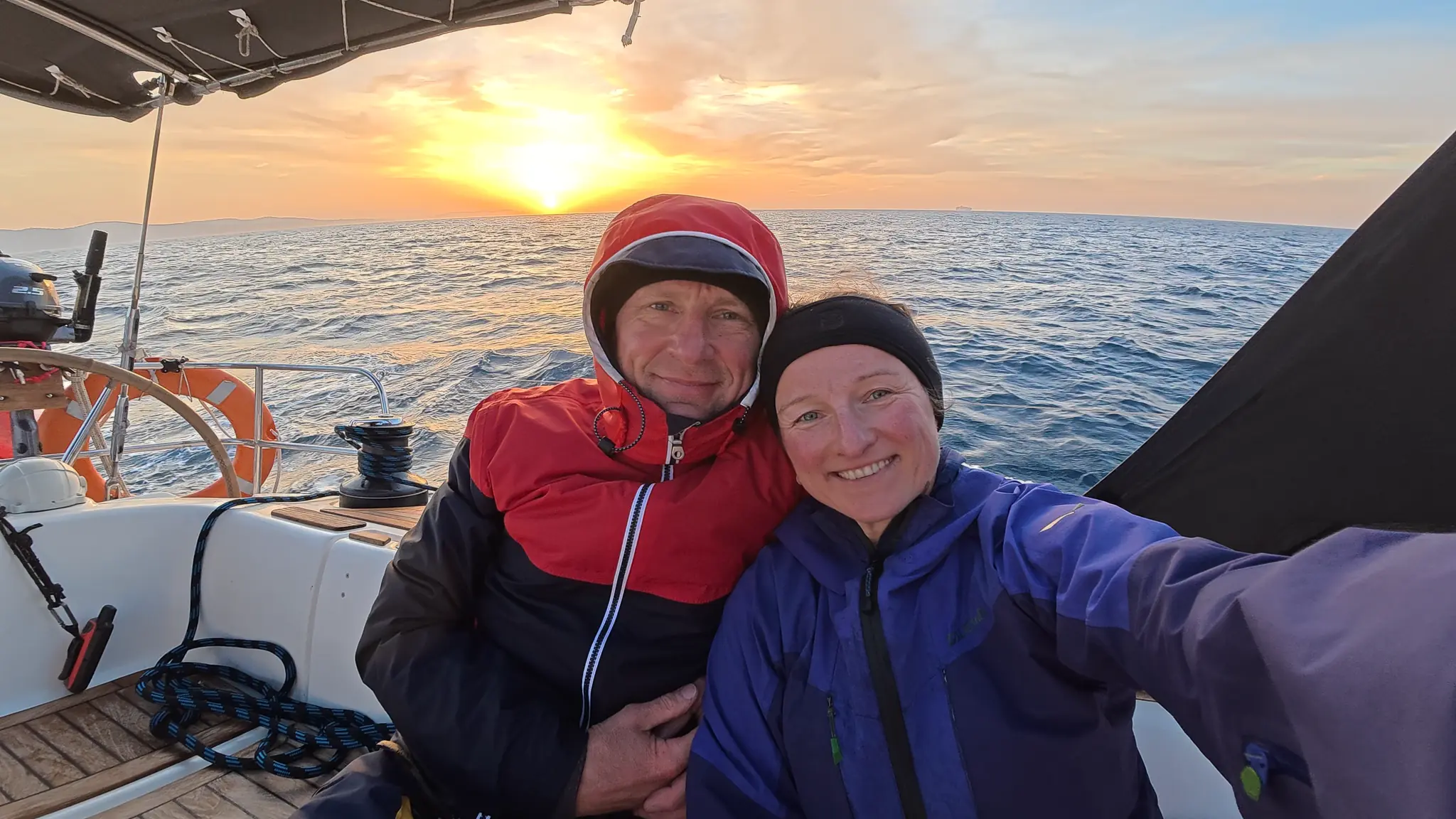
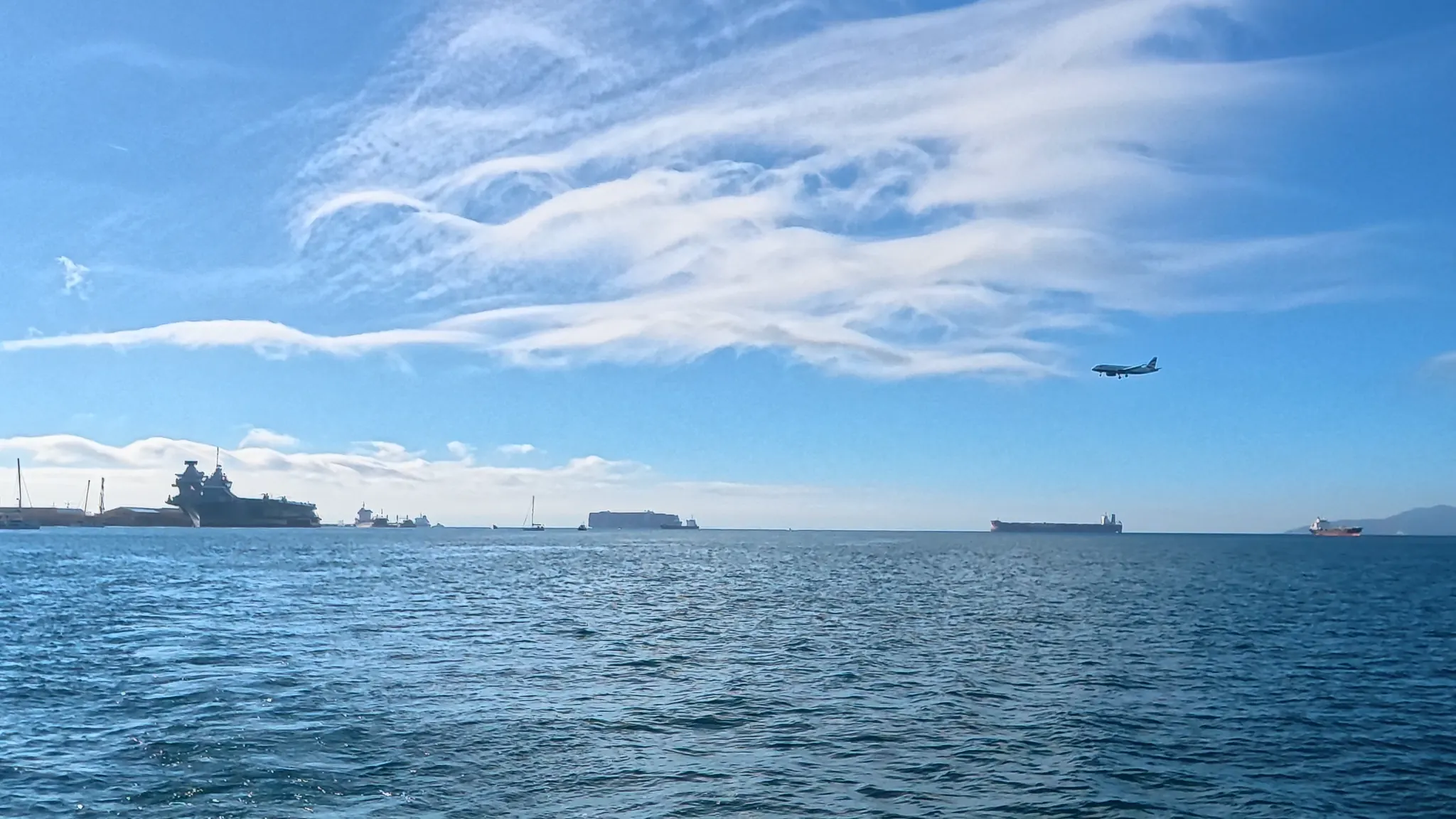
I started the navigation watch, from 22:00 to 2:00, with Rafael. Our crewmates covered the next four hours. Winds and currents were on our side. On Monday morning the Rock of Gibraltar appeared in all its glory. We also found out how low the planes on final approach fly when one passed right over the yacht.
Mooring at Alcaidesa Marina in La Línea, on the Spanish side, meant a whole day for sightseeing.
Across the runway
We walked to the centre of Gibraltar, and the road to the border led straight across the runway of an active airport.
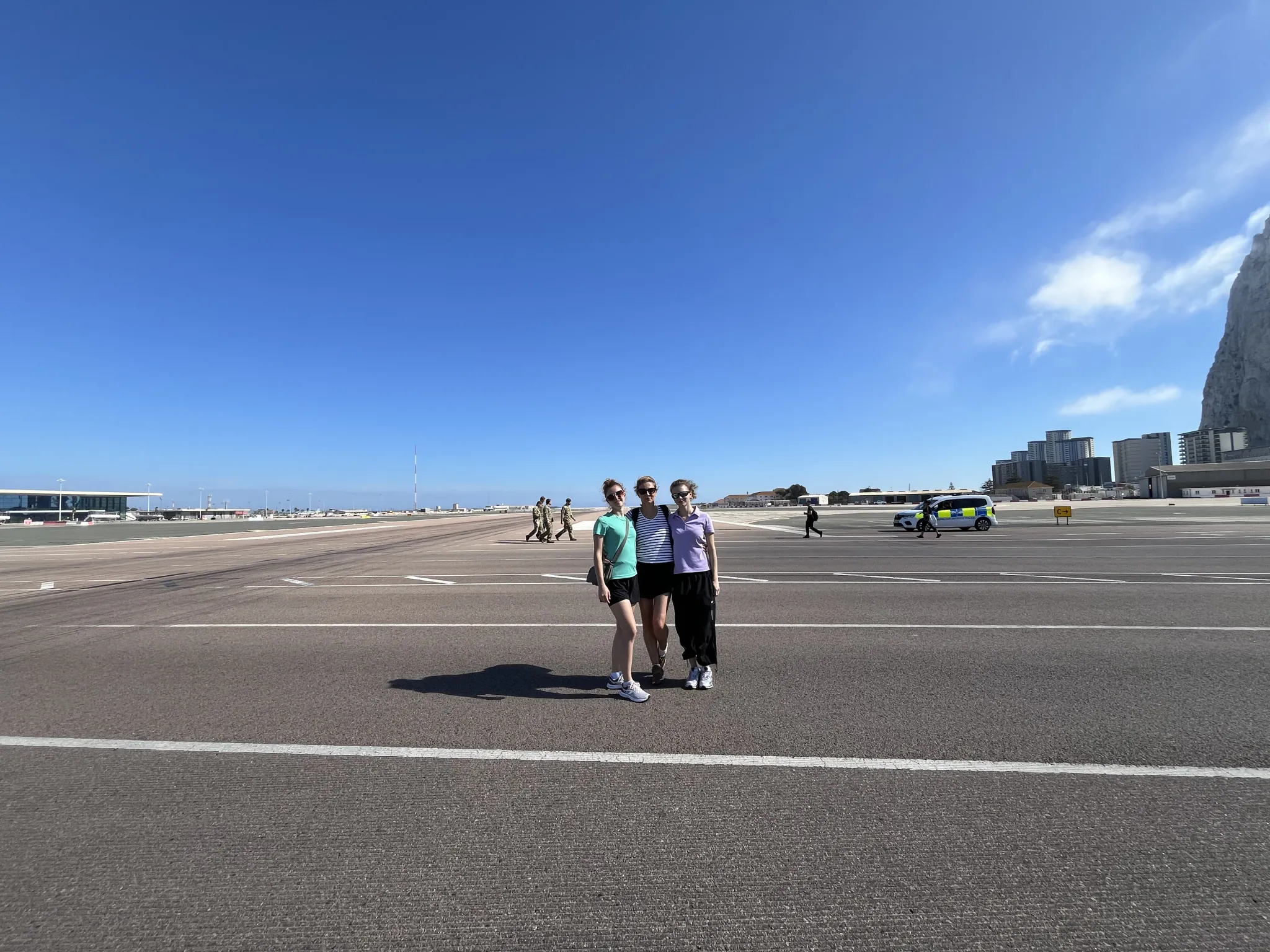
Traffic lights control the pedestrians and cyclists. When a plane is about to take off or land, the light turns red and the crossing closes. It works just like an ordinary pedestrian crossing, except that here the planes have the right of way. Cars used to drive across the runway too. In 2023 road traffic was moved into the Kingsway Tunnel, while the crossing for pedestrians and cyclists was kept. Gibraltar government notice on the runway crossing
Rafael and I had already seen Gibraltar, so the £30-per-person ticket for the paved road up to the top of the Rock was out. The "charming" monkeys did not tempt us either. Instead we chose a walk around the town and local paths up the hill with the cannon emplacement and a good view over the bay.
A sea motorway between continents
Only a sea motorway now separated Vagamonda from Tangier. At its narrowest point, the distance from the Spanish coast to Africa is about 13 kilometres. A photo of the Strait of Gibraltar from orbit (NASA) The navigation screen shows exactly how shipping is organised here: ships have lanes marked out for opposite directions, with a so-called separation zone between them. For container ships it is a convenient route between the Atlantic and the Mediterranean. Yachts heading for Africa have to cross it.
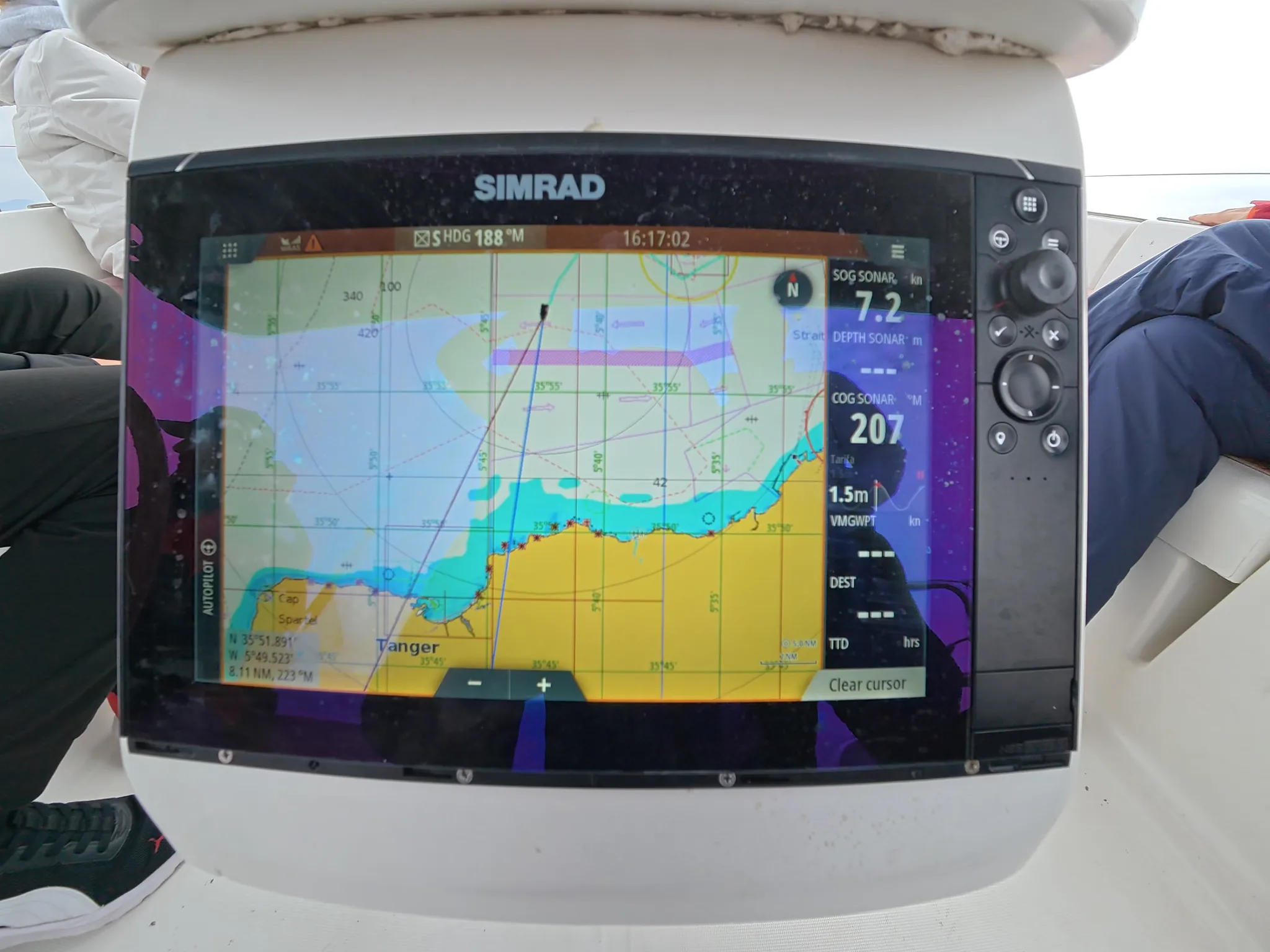
Traffic in the strait is governed by Rule 10 of COLREG. Sailing boats and vessels shorter than 20 metres must not impede the safe passage of a power-driven vessel following a traffic lane. When crossing a lane, the bow should point as close to a right angle to the direction of traffic as possible. That makes it easier for the crews of other vessels to read the yacht's intentions. That is the theory.
While planning the crossing, I had the feeling it was a rabbit's dash across a motorway. The steps: work out where the larger vessels are and how fast they are moving; calculate how long we need to cover the distance; jump in at the right moment and get to the other side quickly. Of course, we also had to take into account the strength and direction of the wind and the current, because they decided how long crossing the lane would take.
Tangier
The crossing went smoothly, and on Tuesday evening Vagamonda was already in Morocco. The skipper collected the passports and disappeared for two hours. Meanwhile the marina staff had finished work, so we spent the first night on the customs quay. The yacht entered Tanja Marina, just beyond the bow, only the next morning, when reception started taking vessels again.
I came back to Morocco after many years, and I still have mixed feelings about it.
Visually, a lot has changed here, at least in the larger cities. The marina and the new centre of Tangier look modern. It is clean and safe, a pair of police officers stands on every corner, and the toilets have porcelain bowls and paper, which is not typical at all for this part of the world. Hotels, restaurants and shops of well-known brands line the main street.
At the same time, the architectural chaos is visible at first glance. Every investor builds as they please. Modern buildings of concrete and glass hide the traditional architecture, and the whole thing seems random.
The medina, picturesquely set on a slope, has fortunately kept its character. It is noisy and colourful, and cats loiter lazily between your feet. Little eateries with mint tea and couscous, and stalls with handicrafts and goods of every kind, are tucked into the maze of alleys. The kasbah, the old fortified part of the city, towers majestically over the medina.
Sightseeing in Tangier took most of the next day. There was one curiosity along the way: scenes for the film "The Mummy 4" (release announced for 2028) were being shot in the medina. Some of the alleys were closed. At every step there were extras in period costume, vintage cars and a crew carrying tonnes of equipment from place to place. New alleys were being dressed in a hurry. During our walk, "hotel" and "cinema" signs and film posters advertising upcoming screenings went up on the walls of a tenement house.
Hunger drove us to the lovely Le Salon Bleu restaurant. From its terrace stretched a great view of the medina's central square, with its collection of old cars, bored extras and bustling film crew, as well as the walls and the bay with the port.
We were about to head back to the boat, but the medina is a labyrinth. Rafael, our friend Radek and I ended up in some side alley. Someone ran past from the opposite direction, and one of the several men standing in front of us suddenly pulled out a large knife and ran in our direction. It quickly became clear that he was looking somewhere behind our backs and was probably chasing the man who had just run by, but for the first fraction of a second it seemed he was running straight at us. My heart jumped into my throat, and I immediately remembered my first visit to Morocco, almost 20 years ago. On the outskirts of Nador we were attacked by two men, one of whom had a knife. It ended with a wounded calf and a long rehabilitation, though it could have been much worse. Something like that could happen anywhere, but for some reason such situations keep happening to me in Morocco.
By train to Asilah
From Tangier we made a day trip to Asilah by train, to test the Moroccan railway while we were at it. The trains on this route resemble Polish express trains from a few years ago, and the stations are quite well kept.
Asilah is a small resort on the Atlantic. In 1471 the Portuguese took the town, as the seaside defensive walls remind you. In the alleys of the old medina, blue reigns on the doors and shutters, and the whole place is very artistic. Stalls with paintings, carpets, blankets and crockery stand so thick here that it is hard to leave empty-handed. A few handmade bowls and an olive-wood chopping board ended up in our luggage. We also had to visit the local market (the kind with fruit and fish) to restock on spices and tea.
On the beach we met a Chilean who has lived in Morocco for seven years. He was walking with a burlap sack, collecting rubbish, mainly plastic bottles and bits of polystyrene. He says he has thousands of such sacks and comes to this beach every day. He tries to educate the local people, but with poor results, so he decided to lead by example.
He was also the source of the information that Tangier's real architectural boom came during the COVID-19 pandemic and right after it. Numerous investors, among them some from China and the USA, took an interest in the city then. He himself prefers Asilah, because it has kept its Moroccan character.
A refreshing swim in the ocean topped off the trip.
Back to Benalmádena
On Friday around noon Vagamonda left Tangier. A long fight with sea currents and waves, another crossing of the sea motorway, and then the yacht reached the Spanish coast. We dropped anchor near Estepona. On Saturday, now in calm waters, we followed the coast and came into Benalmádena again in the evening. Sunday was spent cleaning the yacht and lazing on the beach.