A wasted Sunday
We reached Te Anau in the morning. The day before, SAR rescuers had found us in the Tutoko valley. Now we had to find out why they’d been looking for us at all.
We stayed with Tara and Jim, whom I’d known since the days when we all lived in Mount Cook Village. Tara worked for an airline back then, and Jim was in Search and Rescue. We told them about the helicopter. The operation surprised them, especially since the team had flown all the way from Wanaka.
An angry policeman was waiting for us at the station.
Once we’d confirmed who we were, he almost started shouting. He blamed us for his wasted weekend. Instead of enjoying the good weather, he’d had to investigate mountaineering trips and find out how long an outing like ours should take. He wasn’t a climber, so how was he supposed to know?
He’d received a report that we were supposed to return after three days. It was already our fourth day away. We hadn’t returned. He waited another day and notified SAR.
On Sunday, the Queenstown team was already on another operation, so the call went to SAR Wanaka. Their helicopter flew out to look for us on Tutoko.
Willi’s three days
But where had those three days come from in the first place?
The information we’d managed to find before setting out suggested we’d need five days for the route. Willi, however, was an incurable optimist when it came to estimating how long things would take. He reckoned we’d get round it faster.
Before the trip, we’d stayed at Homer Hut. It’s a mountaineering hut run by the New Zealand Alpine Club. The regular warden was away, and the man standing in for him knew little about the realities of mountaineering in Fiordland.
The evening before we set out, Willi talked to him about our plans. Asked how long our mountaineering trip would take, he said three days. The man took that at face value. When we didn’t return on time, he grew worried and called the police.
The neighbour next door
It was all starting to make sense.
Towards the end of the conversation, we were asked where we lived.
I’d been wandering around for several months. I was effectively living in my green estate car, a Nissan Wingroad California I’d named Hotel California. But I thought that if I told this angry policeman I lived in a car, he’d really tear into us.
To be on the safe side, I said Mount Cook Village, where I’d lived and worked before hitting the road.
The policeman softened.
"My brother lives there too," he said.
I asked his name. Everyone knew each other in that little village, so I’d probably know him.
"Duncan. He works for Heli Lines."
I smiled. Duncan had been my next-door neighbour! We shared a wall.
When I told him, the policeman brightened up at once. Instead of the cost of the search and his wasted weekend, we were now chatting about Duncan.
Gear outside the garage
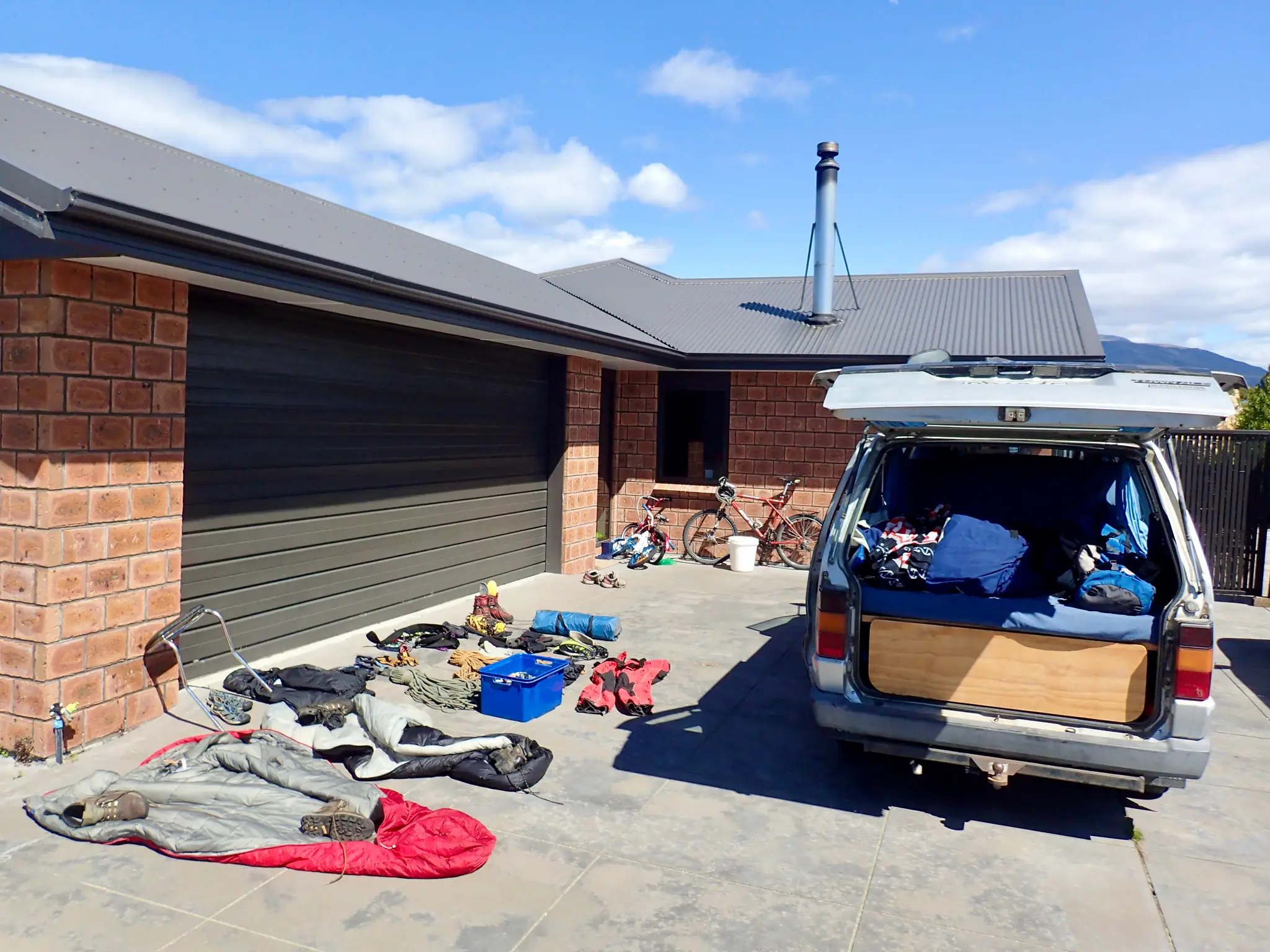
Back from the police station, we spread the contents of our packs out in front of our friends’ garage.
Climbing gear: a long single rope, nuts, cams, slings, carabiners and quickdraws. Harnesses and helmets. Plus crampons, two ice axes each and a snow stake.
Camping gear: a tent, sleeping bags, mats, a stove and gas. I also had a fleece blanket because my sleeping bag was very thin.
Other bits: warm clothes, gaiters and sandals for crossing rivers and streams.
All of that, plus food and water, had been on our backs for five days.

Hunger and smaller cups
For Tutoko, I’d packed roughly as much food as I would for an ordinary tramping trip, without allowing for a much more demanding outing. Steep ascents, fighting through dense bush, heavier packs than usual, heat, difficult terrain. I’d badly underestimated how much energy my body would need. Even in the first few days, I wasn’t eating enough, saving the high-energy food for the summit attempt.
Afterwards, I noticed that my bra was oddly loose. In those five days, I’d lost about two cup sizes. Finally, my breasts had come in useful for something practical, I thought. An energy store for the Tutoko mission!
Once we reached Te Anau, though, we ate almost all day. Breakfast rolled straight into lunch, and lunch into dinner. We had some depleted reserves to replenish 😉
High pressure for the rescuers
One thing still didn’t add up.
I was already a member of land-based Search and Rescue. I knew the procedures for assessing reports and the points-based system for evaluating a situation. Before deciding to launch an operation, they considered factors including the climbers’ experience, their equipment and the weather. When I put together what was known about our trip, I couldn’t see why a helicopter should have been sent. The policeman couldn’t explain how our case had been assessed.
A few months later, while climbing around Wanaka, I met a rescuer from the local SAR team. As we talked, it came out that I was the person they’d been looking for on Tutoko.
I asked why they’d flown out at all, and all the way from Wanaka.
He laughed.
According to him, the guys had received a report about two climbers who hadn’t returned on time. They looked at the weather map. High pressure. Sunshine over Fiordland. A very unusual situation.
He said they’d previously flown there mainly with body bags. This time, they had a chance to see Tutoko in beautiful weather, do some reconnaissance and take a proper look at the terrain. According to him, that was what tipped the decision in favour of flying. Besides, the weather was due to break on Monday. If something had happened to us, Sunday was their last chance to find us.
Then I understood the relaxed attitude of the rescuers we’d met in the valley a little better.