Amro’s number
As soon as we had all the paperwork, I messaged Amro to say we were ready to go. A moment later he picked us up outside the hostel.
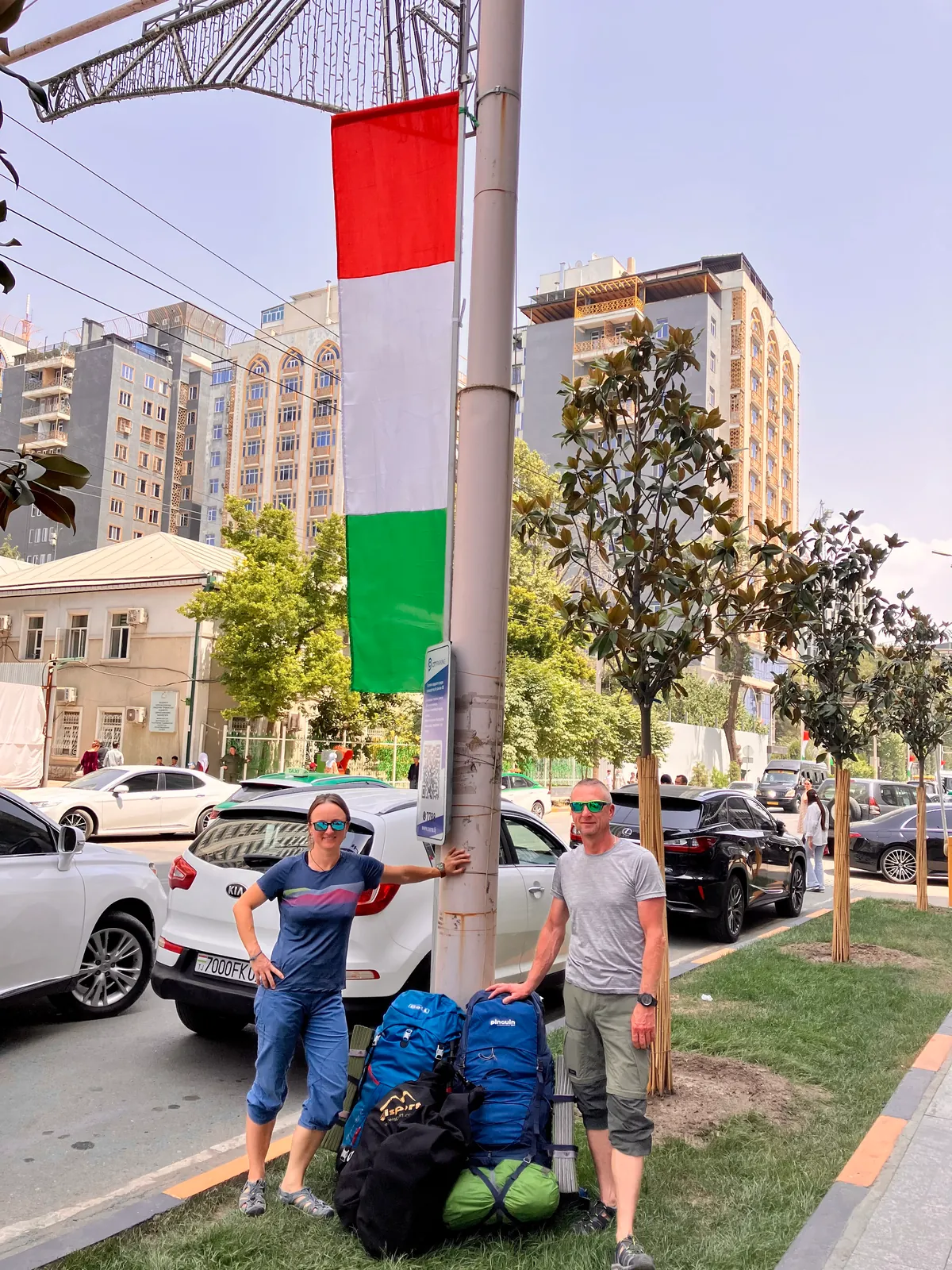
Amro was a young, capable taxi driver we had met the previous day. When I asked whether he would drive us to Sarvoda, about 100 kilometres away, he looked a little unsure. He had never been that far north. But curiosity and a guaranteed fare won out. We arranged all the logistics over WhatsApp.
On our way out of the city, we stopped at a shop selling gas for the stove.
I wouldn’t ride a motorbike through here
At first the road was quite good, but the further north we went, the more interesting it became. Towards the end of the journey, we entered a series of galleries and tunnels cut through the rock. The longest of them, the 5-kilometre Anzob, had earned the unfortunate name Tunnel of Death.
Inside, the lighting was poor and the road surface left a lot to be desired. Impatient drivers overtook three abreast, even though the tunnel carried traffic in both directions. Water dripped from the walls. Ahead, the darkness was broken by faint red dots of brake lights and the harsh white glare of headlights coming towards us. Motorcyclists were using the tunnel too. Rafał and I both ride motorbikes, so it wasn’t hard to put ourselves in their place. I don’t think I would have dared ride through there.
I only learned the history of the Anzob Tunnel later. Construction began in 2003, and in 2006 the unfinished tunnel opened to traffic. It lacked a proper road surface, lighting, ventilation and drainage. Water flooded the road, and exhaust fumes accumulated inside. Cars drove through what was still a construction site. Reports of fatal carbon monoxide poisoning and the tunnel’s grim reputation date from that period. Eurasianet, a report from 2007
At stake was a year-round connection between the capital and the north of the country. The old road crossed Anzob Pass at around 3,372 metres and was sometimes impassable because of snow. The alternative was a detour through Uzbekistan, but with relations between the neighbours strained, a border closure could cut off that route. The tunnel, lower down at around 2,700 metres, made it possible to travel from Dushanbe to Khujand without relying on the goodwill of the Uzbeks.
Tajikistan and Iran jointly financed the project. An Iranian company carried out the construction. For Iran, those 5 kilometres formed part of a much bigger plan: a trade corridor through Afghanistan and Tajikistan all the way to China, described as a new Silk Road.
Anzob underwent repairs and upgrades over the following years. Unfortunately, the name outlasted the renovations. It still falls short of European standards, but driving through it no longer means entering a death trap.
10 minutes
In Sarvoda, the local wheeler-dealers descended on us straight away. Alaudin was about 25 kilometres away. They wanted 800 somoni for a lift. For comparison, we had paid 350 somoni for more than 100 kilometres from Dushanbe in an electric taxi.
We set off on foot, planning to hitchhike. Before long, an off-road vehicle stopped. We picked up an elderly woman along the way. The driver dropped everyone off in a small village and told us to wait: a friend of his would be coming through soon and could take us further.
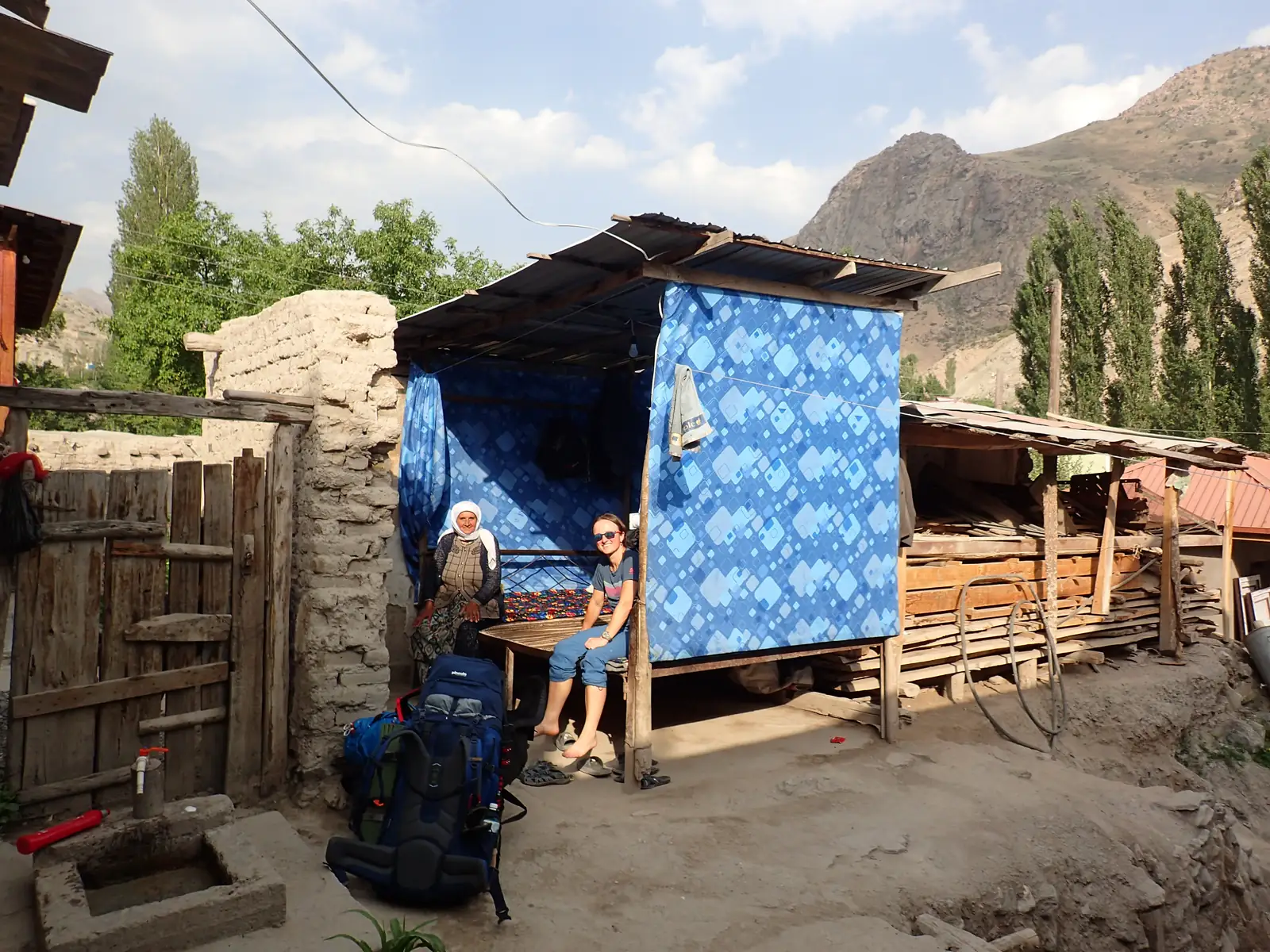
A woman immediately came out of a nearby house and invited us for chai. The elderly woman went in, so we did too. We had barely arrived when sweets, lepyoshka, fresh cherries and tea (chai) were already on the tapchan. Children came running from the nearby villages. They chatted away cheerfully, trying to remember a few English and Russian words.
The elderly woman was very curious about what we were doing there. We tried to talk, partly in Russian and partly through gestures. I showed her the guidebook and pointed out on the map where we were heading.

An hour passed. No driver.
Eventually he called to say he would be there in 10 minutes. Another hour passed before he arrived with supplies. Only then did we notice the small shop beside the house. We helped unload the goods and set off again.
So much for hitchhiking
The elderly woman got out in the next village. We kept going.
The bumpy road brought us to the barrier of the post-Soviet Alaudin Vertical mountaineering camp. It was already dark. The campsite looked deserted. Eventually a guy with a torch appeared and opened the gate.
We took our packs and asked the driver how much he wanted for the lift. 600 somoni. We offered 400. We settled on 500.
So much for hitchhiking.
Only later did we learn that giving people lifts for a small fee was perfectly normal in Tajikistan. The price was another matter. Not every driver’s rates were fair.
At the campsite, we started looking for a place to pitch our tent. A man pointed us towards an inflatable tent that was already up. It reminded us of Himalayan base camps. We said we had our own, but he kept encouraging us to use it since it was standing there anyway. To be on the safe side, we immediately asked how much it would cost. Surprisingly, he didn’t want any money. Or we could give whatever we thought appropriate.